
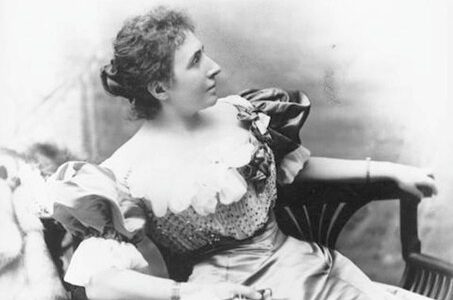
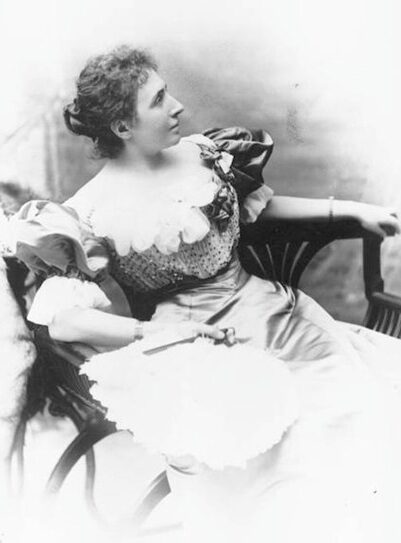
Milka Ternina (December 19, 1863 – May 18, 1941) was a Croatian dramatic soprano who became an absolute musical star at the turn of the 19th to the 20th century. She performed on the world’s greatest opera stages and collaborated with the most prominent conductors of her time, with Arturo Toscanini in particular praising her as “the greatest artist in the world.” In the history of world opera, she is known as “the great, legendary Ternina,” a title by which she is listed in all encyclopedias.
During her 24-year brilliant career, she gave around 1,200 performances, performing 65 demanding soprano roles. Her vocal technique, expressive musicality, and powerful stage presence earned the admiration of both audiences and colleagues, including the celebrated tenor Enrico Caruso, who openly praised her performances.
She particularly excelled in the Wagnerian repertoire, shining in roles such as Elsa (Lohengrin), Eva (The Mastersingers of Nuremberg), Senta (The Flying Dutchman), Brünnhilde, Kundry (Parsifal), Ortrud, Brangäne, and Isolde (Tristan and Isolde). Her interpretations of these roles are still regarded as unsurpassed models. She also gained great fame as one of the first interpreters of Tosca, performing the role at the premieres at London’s Covent Garden in 1900 and at New York’s Metropolitan Opera in 1901, with Giacomo Puccini himself calling her his “ideal Tosca.” Critics praised her thrilling dramatic power and perfect singing.
She debuted at the Zagreb Opera in 1882 as Amelia in Verdi’s Un ballo in maschera. This was followed by permanent engagements at leading opera houses in Germany and Austria: Leipzig (1883–1884), Graz (1884–1886), Bremen (1886–1889), and Munich (1889–1899), where she was awarded the title of Royal Bavarian Court Singer. She also performed in Bayreuth, Prague, Venice, Moscow, Zurich, Zagreb, and the USA, receiving particular acclaim at London’s Royal Opera Covent Garden and New York’s Metropolitan Opera.
Ternina paid special attention to her elaborate costumes, which were carefully studied and made, with the finest designed by Percy Anderson in London. Many of these are now exhibited at the Museum of the City of Zagreb as part of the rich collection of her personal legacy.
At the peak of her career, in 1906, health problems – facial nerve paralysis – forced her to retire from the stage. Nonetheless, she remained active in Zagreb’s musical life. Upon returning to her homeland in 1923, she became an honorary member of the Academy of Music and head of the Vocal Department, where she taught new generations of opera singers. Her most famous student was Zinka Milanov, one of the greatest spinto sopranos of the 20th century, whom Ternina recognized as her successor.
Milka Ternina passed away on May 18, 1941, in Zagreb at the age of 77. Although she left no studio recordings, surviving written records, critiques, and testimonials confirm her extraordinary artistic greatness. She is considered one of the brightest operatic figures of the Belle Époque.
Besides being a great artist, she was a true humanitarian and a friend of Nikola Tesla. In 1897, she performed in Wagner’s Tannhäuser at the Croatian National Theatre in Zagreb, donating all proceeds to the Society for the Beautification of Plitvice Lakes. In gratitude, one of the most beautiful waterfalls in Plitvice bears her name – The Milka Ternina Waterfall, a lasting tribute to this remarkable artist.
In her diary, she wrote:
“Experience makes a person richer, but the heart grows poorer; there is no happy life, only days of happiness; when a noble woman joins with genius, the world receives a double blessing from her work. One must be noble!”